
Boral Roof Repair in Whitney: A Homeowner’s Guide
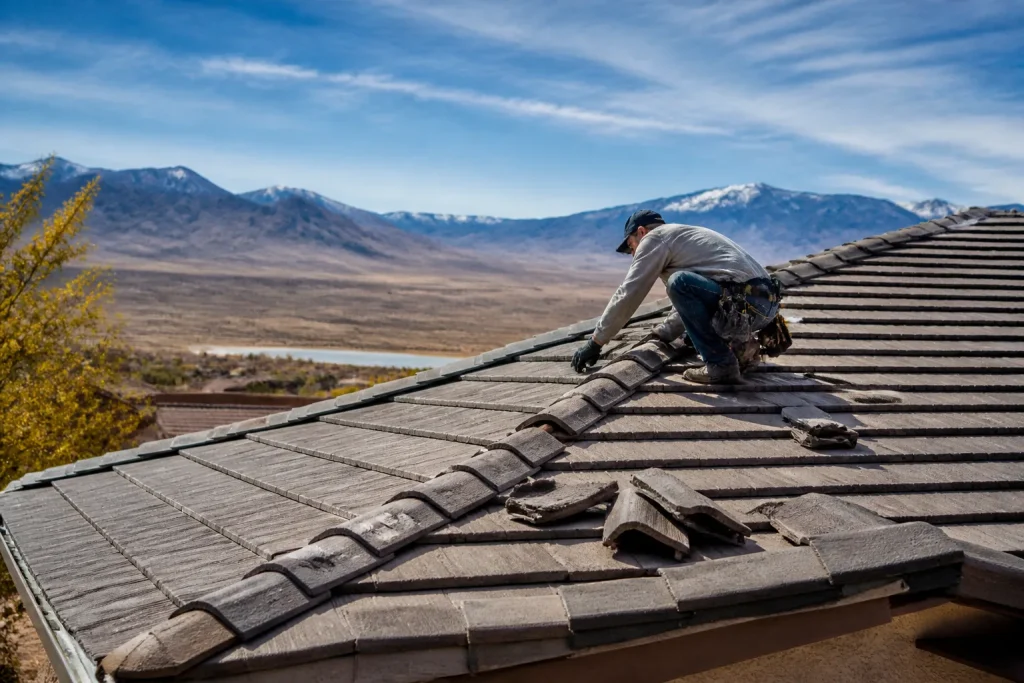
Boral concrete tiles are rated for 50 years, yet we see them repaired wrong inside the first decade almost every time – usually because the contractor grabbed the wrong mortar color from the truck and called it done. A proper Boral repair in Whitney means matching the tile, the mortar color and mix, and the flashing underneath, not just filling a crack. If you’d rather not sort through that yourself, call (844) 797-9455 and we’ll take a look.
Key Takeaways
- Boral concrete tiles crack differently than clay or asphalt because of their concrete-composite expansion rate in Nevada’s heat swings.
- Mortar color and mix ratio both matter. Getting either wrong means a repair that fails in two or three summers.
- A cracked tile is sometimes cosmetic and sometimes a sign of moisture in the substrate below it. You have to know which.
- The flashing at the ridge cap is where we find the real problem most of the time, not the tile everyone points at.
- Keep your paperwork. Boral’s warranty interacts with repair work, and documentation decides whether a claim holds up.
Why Boral Concrete Tiles Crack Differently in Whitney
Boral’s concrete composite tiles are dense. They hold up to sun and hail better than asphalt, and they don’t chip the way thin clay can. But dense concrete moves differently under heat, and that’s where Whitney roofs get into trouble. Summer surface temps on a south-facing roof here can swing more than 100 degrees between an August afternoon and a January morning. Every material expands and contracts across that range, but concrete composite does it at its own rate.
What that means for you: cracks in Boral tiles usually show up along the tile’s long axis or near the fastener points, not randomly. When a tile cracks near where it’s nailed or screwed down, the roof deck below has been moving against a tile that can’t flex with it. When it cracks along the middle, it’s often a thermal issue on the sunniest part of the roof. That difference matters, because a roofer who patches the crack without asking why it cracked is going to be back next summer. In our experience across Whitney, the tiles that fail earliest are on the west and south slopes, where afternoon sun does the most work.
This is also why asphalt and clay tile repair habits don’t carry over. A roofer who mostly sets asphalt shingles will treat a Boral crack like a shingle tear and seal it. The seal holds for a season. Then the freeze-thaw cycle of a high-desert winter works it loose again.
The Mortar-Matching Problem: Why Color and Mix Both Matter
Here’s the part most homeowners never hear about. When a Boral tile is bedded or pointed with mortar, that mortar has to match the tile not just in color but in mix. Boral makes matching mortar products for its tile lines, and the color is a real specification, not a preference. A repair done with a generic gray mortar on a brown or charcoal tile will be visible from the street within a year, and it won’t weather the same way.
Mix ratio matters just as much. Mortar that’s too rich dries hard and brittle and cracks away from the tile when the roof moves. Mortar that’s too lean crumbles. Either one leaves a gap where water gets in. We’ve pulled apart repairs where the mortar looked fine from the ladder and then crumbled into dust when we touched it, because it was mixed for speed instead of for the tile.
What a proper Boral repair looks like on the mortar side:
- Matched color from the tile manufacturer’s line, not a hardware-store bag that’s “close enough.”
- Correct mix ratio for the tile and the climate, so the mortar flexes with the roof instead of fighting it.
- Proper curing time before the tile sees weather or foot traffic.
- Full bedding and pointing, so the tile seats flat and water sheds the way it was designed to.
If a contractor shows up and the mortar bag doesn’t say Boral or a tile-matched equivalent, ask why. You’ll usually get an honest answer or a shuffle.
Cosmetic Crack or Moisture Problem Underneath?
Not every cracked Boral tile in Whitney means trouble. Some cracks are surface-level hairline fractures that come from a footstep during a repair or a stray branch, and the tile still sheds water fine. Others are the tip of a moisture problem in the substrate underneath. Telling them apart is the whole job.
Here’s how we sort it out:
- Look at the crack pattern. Hairline cracks that run short and don’t reach the tile edge are usually cosmetic. Long cracks that run edge to edge or branch out are structural and need a replacement.
- Check for staining. Dark streaks or efflorescence (that white chalky stuff) around a crack usually mean water’s been getting under the tile for a while.
- Press on the tile. A tile that feels loose, rocks, or sits higher than its neighbors has likely come off its bedding. That’s a substrate issue, not a cosmetic one.
- Check the underlayment and deck. Pull the cracked tile and look below. Soft decking, damp underlayment, or rusted fasteners underneath mean the crack is a symptom, not the cause.
If it’s number one, you can often get away with a replacement tile. If it’s the other three, a repair that only addresses the tile is going to fail. We pulled a job over on a Whitney hillside last month where three cracked tiles had been pointed twice by another outfit, and the deck underneath was soft enough that the screws pulled loose by hand. No amount of mortar fixes that.
What a Proper Boral Inspection Actually Checks
When we look at a Boral roof, the cracked tile is the last thing on the list. It’s the easiest thing to point at, but it’s usually not where the water’s getting in. Here’s what earns the repair:
- The ridge cap flashing. Ridge caps are where wind-driven rain gets underneath, and the flashing that seals them is the first place we check. Tile roofs leak at the caps before they leak at the field of tile.
- Valley metal. Every roof valley on a Boral roof sends a lot of water down one channel. If the valley metal isn’t set right or the tiles aren’t cut back properly, water backs up under the tile.
- Penetrations. Pipe boots, vent stacks, satellite mounts. Small leaks here love to show up as a cracked tile ten feet away after water migrates under the tile field.
- Tiles that aren’t seated. Loose tiles tell us the bedding or fasteners failed, which means the whole area needs attention, not just the tile that cracked.
- The eave and fascia. Water that can’t get past a blocked eave can back up under the tile and crack it from below during a freeze.
If you’ve had a leak chase from one roof slope to another and nobody’s found it, this check is usually where the answer lives. If you need help from someone who checks all of that on every call, our Roof Repair in Whitney team describes our process.
Boral’s Warranty and Your Paperwork
Boral’s warranty is often misunderstood. The manufacturer’s tile warranty covers defects in the tile itself, and it doesn’t cover leaks or failures from installation or from a repair done with non-matched materials. That’s why when you have Boral repair work done on your Whitney roof, documentation matters.
What to keep:
- The original tile documentation from when the roof was put on, if you have it. Serial numbers and product codes matter for a claim.
- Written descriptions of every repair, with the products used, the mortar color and mix, and the date.
- Photos of the underlayment and deck before the repair, not just the finished tile.
- The name and license number of the contractor who did the repair. A paper trail means Boral can trace who did what when.
If you’re buying a home in Whitney that already has a Boral roof, ask for the same documents. A roof that’s been repaired without matching mortar or a paper trail is a smaller risk, but it’s a question worth asking a seller. The tile itself is built to last. The warranty is only as good as the records behind it.
When to Call a Pro on a Boral Roof
The short answer: any time the crack reaches the tile edge, any time the tile feels loose under your foot, and any time you can’t see what’s under the tile without pulling it. Tile roofs aren’t a place to walk around and poke at things. Concrete tiles crack under a heavy footstep, and each crack you make costs more than the repair you set out to do. The deck underneath, the underlayment, the flashing and the substrate aren’t things a homeowner should be pulling up to investigate.
If you’re already seeing multiple cracked tiles, or cracks keep coming back in the same spot, that’s the other sign. One crack is a tile. Three cracks in the same area are the roof telling you the substrate underneath needs a look. For anything beyond a broken tile that a pro will replace, that goes to the roof repair team in Whitney or, if the deck and underlayment need more than a spot fix, to the crew that handles Roof Replacement & Installation in Whitney. If your Boral roof also has metal sections or the repair includes metal valley work, our Metal Roofing in Whitney crew coordinates on those. And for anything you’re sorting out on the rest of your house, our Shepherd & Sons Roofing Whitney home page lays out what we do.
Related services in Whitney: Roof repair, roof replacement, metal roofing and gutters.
The Bottom Line
Boral concrete tiles are a good roof. They’re just not a forgiving one when repairs are done with the wrong mortar, the wrong approach, or without checking what’s underneath. If your Whitney roof has a cracked tile, the fix is worth doing right the first time. Matched mortar in the right color and mix, a look at the flashing and the substrate, and a paper trail you can hand to the next buyer. That’s a proper Boral repair.
If you’re in Whitney and need help, Shepherd & Sons Roofing Whitney offers free estimates and a free second opinion on any written quote you’ve already got. One call brings Bill back if something isn’t right, and we back every roofing job with our written 90-Day Done Right Promise. Call (844) 797-9455 to schedule your free estimate.
Frequently Asked Questions
Most Boral tile repairs in Whitney run $400 to $1,200, depending on how many tiles are involved and whether the underlayment or deck needs attention underneath. A single cracked tile replacement sits at the low end; a repair that pulls several tiles and addresses flashing or underlayment sits higher. Call (844) 797-9455 for an exact quote – estimates are free.
No, if you get it in writing first. Sometimes a repair reveals soft deck or a failed underlayment under the cracked tile, and that’s real additional work – but you should see the deck photos and the revised number before we touch anything. Ask any contractor for a written, line-item estimate before work starts. Call (844) 797-9455 for a straight quote.
It’s not a job we’d recommend. Getting a replacement tile off and a new one seated without cracking the neighbors takes experience, and you can’t see the underlayment or deck from the top. If you’re standing on a tile roof and can hear a crack under your boot, that’s already the least safe place to be. Call (844) 797-9455 and we’ll take a look.
It can. Boral’s tile warranty covers defects in the tile, not the installation or the repair. A repair done with non-matched mortar or unapproved materials can complicate a claim. Keep every repair in writing, with the products used and the contractor’s license number. Call (844) 797-9455 for a free second opinion on any repair you’ve had quoted or done.
Written by the team at Shepherd & Sons Roofing Whitney.
Need Roofing Help?
Call Shepherd & Sons Roofing Whitney - the local pro we connect you with is licensed and insured, here with fast after-hours help in Whitney.
(844) 797-9455