
Top Signs You Need Roofing Service – Don’t Ignore These
Granules in the gutter shows up on every roofing warning-sign list ever printed, and it’s a real sign. But it’s not the one that costs Whitney homeowners the most money. What costs them is the blister pattern on south-facing shingles after three straight summers over 100 degrees, and the too-hot attic nobody climbs into to check. If you’d rather have eyes on your roof than guess from the ground, call (844) 797-9455 and we’ll come look for free.
Why generic warning-sign lists miss what actually happens to Whitney roofs
Most “signs you need roof repair” lists are written for a national audience, so they land on the same five things: curled shingles, missing shingles, sagging, granules in the gutter, water stains on the ceiling. Those are fine. They’re also late. By the time a shingle is curled enough to spot from the driveway, the deck under it has usually been taking on moisture for a while.
Whitney’s climate runs the roof differently. Summers that string together day after day over the century mark, high UV at this elevation, and swings from hot afternoons down into cold desert nights all work the shingles harder than the same product would face in a milder zone. We install Tamko, GAF, CertainTeed, and Boral because those lines hold up out here, but no shingle outlasts the sun forever. The signs show up earlier if you know where to look, and they show up in a different order than the magazine version. In our experience around Whitney, the roof tells you it’s aging about a year before anything drips into the house – if you’re paying attention to the right indicators.
- Blisters and cupping on the sun-facing slopes, not the shaded ones
- Attic heat that climbs faster than the outdoor temperature does
- Flashing failures at chimneys and skylights, before any interior stain
- Daylight patterns in the attic that reveal deck movement
- One interior sign that almost always means the leak started months ago
Key takeaways: the warning signs worth acting on in Whitney show up on the roof and in the attic first, indoors last. A free second opinion on any written estimate costs you nothing and tells you whether you’re looking at a repair or a replacement.
Blisters and cupping: the high-UV pattern that means accelerated aging
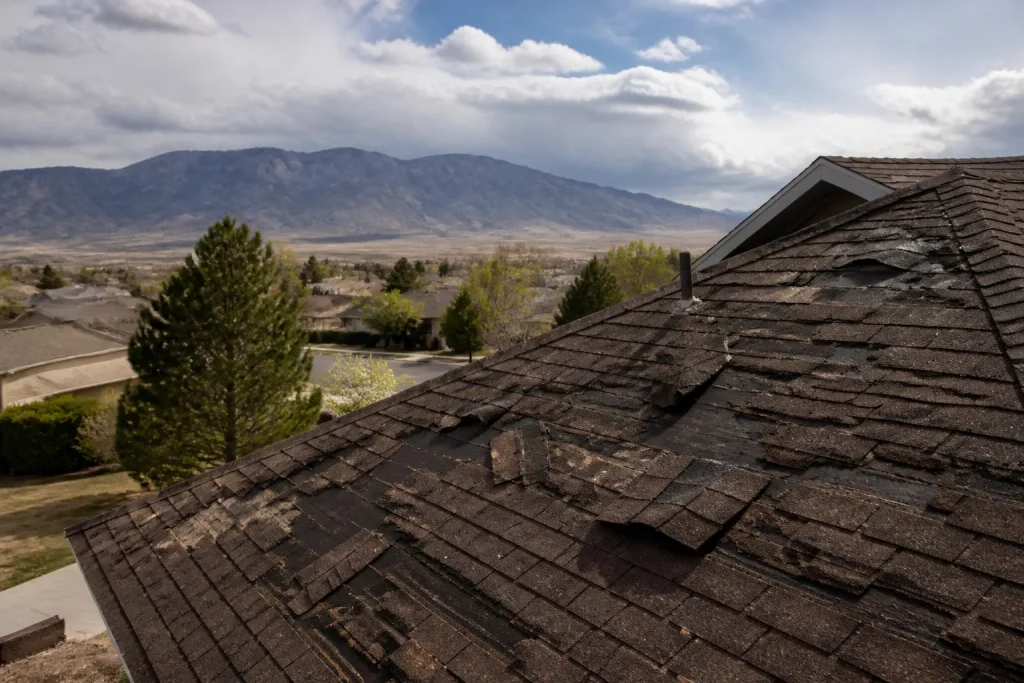
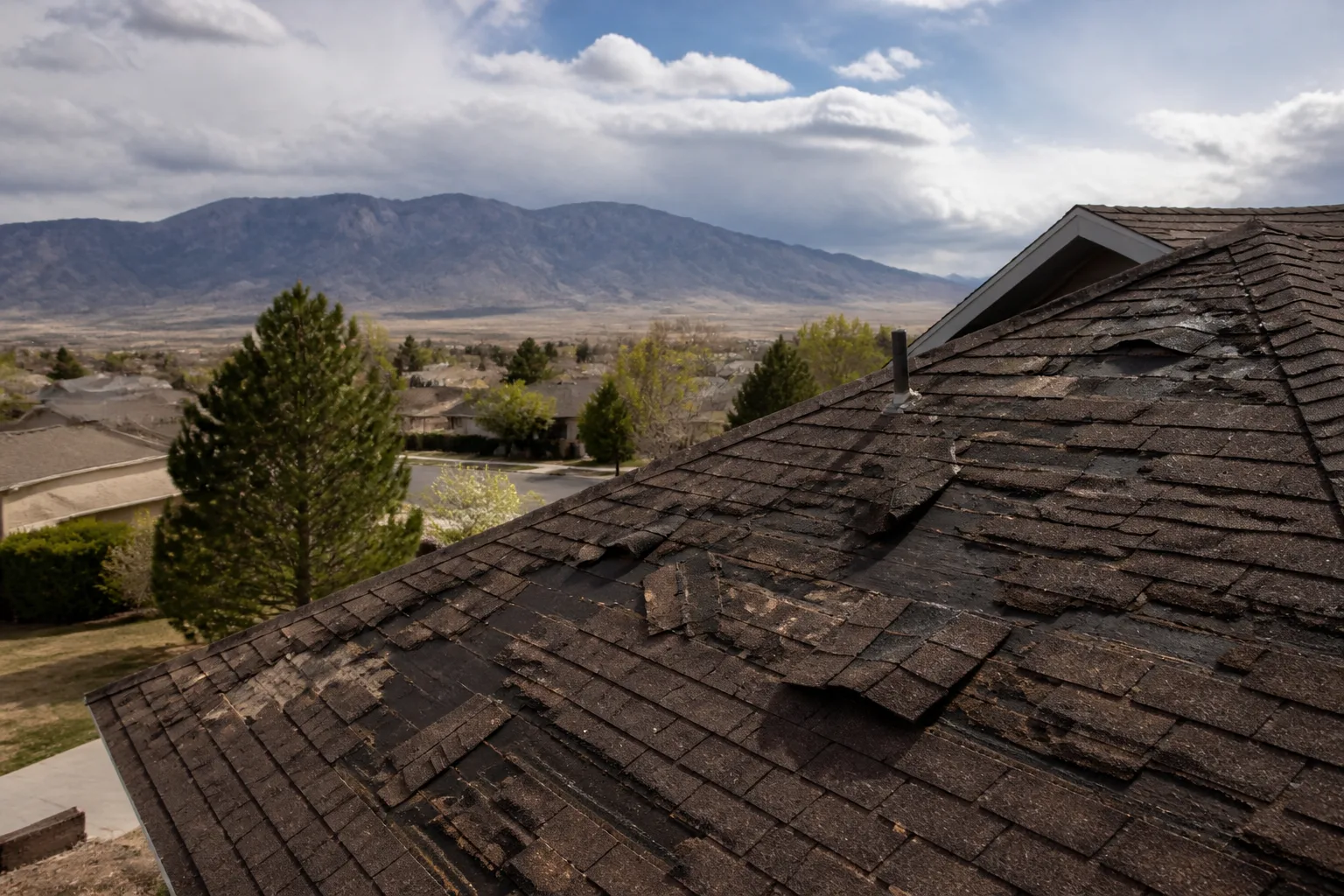
If a shingle on a south or west slope is blistered, the granules have popped loose from the asphalt underneath. It looks like small raised pimples across the surface. Under a Whitney summer, once that blistering starts, the shingle is losing its reflectivity and its flexibility at the same time – the exact combination that leads to cracking at the next cold snap. This is not the same as normal wear, and it’s the single pattern we see most often on homes that are 12 to 18 years into their roof here, earlier than a homeowner expects for a product rated for longer.
Cupping is the neighbor of blistering. The shingle edges turn up like a dish and the field of the shingle starts to look wavy. Once a shingle cups, it’s no longer sealing down in the wind, and its underside is exposed to moisture. Run your eye up the south slope of your roof mid-afternoon when the sun is on it – that’s when blistering and cupping are easiest to spot from the ground.
What it means for time. Blistering on a handful of shingles is a repair conversation. Blistering spread across a whole slope, especially with cupping mixed in, points toward replacement, and putting it off means water finds the deck. Roof Repair in Whitney covers how a focused repair buys time, and when it stops making sense.
Attic temperature is the first indicator almost nobody checks
On a 105-degree Whitney afternoon, a healthy attic runs warm – that’s normal. What isn’t normal is an attic that climbs well above the outdoor temperature and never sheds the heat. Go up there on a hot day, or have someone go up, and pay attention to how it feels against the outdoor air. If the attic is dramatically hotter than the yard, the roof’s ventilation is failing. That tells you the deck underneath is cooking.
Deck heat is what quietly kills a roof from the inside out. Overheated sheathing dries, cups, and pulls at the nails. Shingles bake from underneath as well as from above. When the deck starts to move, the shingle bond above it breaks down and you get the blistering covered above – a feedback loop the attic started. Add ventilation or repair it, and you slow the clock. Ignore it, and you’ll be replacing sheathing along with shingles.
Two quick attic checks while you’re up there:
- Feel the temperature – high heat against your face means heat is trapped.
- Look for damp decking – soft spots, dark streaks, or condensation on the underside of the sheathing.
If the attic is too hot and the deck is soft, that’s a pro’s job. Climbing around an attic and roof in Whitney summer heat isn’t worth the risk to your knees or your footing – call (844) 797-9455 and Bill will come out.
Flashing failures at chimney and skylight bases show up before a leak
Flashing is the metal that seals where the roof meets something sticking up: chimney, skylight, vent pipe, the wall of a dormer. It’s the weakest point on any roof and the first place water gets in. In a Whitney summer, the metal expands and contracts hard every day with the heat swing, and the sealant under it cracks. That’s when water starts testing the joint before you’ve seen a drop inside.
What to look for before there’s a stain:
- Curling or lifting flashing edges at the chimney base – the metal should sit flat against the shingles.
- Cracked or missing sealant along the flashing line.
- Rust streaks running down the chimney or skylight frame.
- Gaps between the flashing and the shingle course where they should overlap.
Any of these and water is already getting past the surface. Caught at this stage, re-flashing a chimney or skylight is a repair, not a leak that’s soaked a ceiling and a wall cavity. Roof Replacement & Installation in Whitney explains what happens if the flashing failure goes far enough to compromise the deck under a skylight.
What “daylight from the attic” really means
You’ll hear people say “if you can see daylight through the roof from the attic, you’ve got a problem.” True, but not all daylight means the same thing. A pinhole or two where a nail missed could be a minor gap. A pattern of light along a line, or daylight showing around a nail with a dark ring, is telling you the deck has separated or the shingle has lifted away – that’s movement, and movement means moisture is already getting in at that seam.
What to look for:
- Streaks of light along a course – the shingle has lifted off the deck.
- Light rings around nails – the shingle above has pulled away at that nail.
- Light at the ridge or valley – a structural gap at a critical seam.
Put your hand up near the light on a cool, dry morning. If it feels wet or cool, moisture is coming in and the daylight is telling the truth about a leak. The pattern matters as much as the fact of the light. A few isolated pinholes are one thing; a line of daylight is a call to a pro.
The interior sign that almost always means the leak started months ago
Here’s the one that gets missed: discoloration or bubbling in the paint or ceiling – a faint brown ring, a spot that looks like a water mark, or paint that has begun to blister – with no active drip. Homeowners see the ring, decide it’s old, and move on. In our experience, that ring is a leak that has been feeding into the ceiling cavity for a while. Water gets in at the roof, travels along a joist or a rafter, and only shows up inside after it has soaked through drywall. By the time a ring appears, the wet has usually been traveling for months. That’s the point where a small repair can become a drywall, insulation, and sometimes framing job.
The move: press the plaster or drywall around the discoloration. Soft or spongy means wet. Then get up on the roof and look at the area above the stain – you’ll usually find the flashing or seam issue directly overhead. Don’t paint over it. Painting over a water mark is how a small leak turns into a big check. If the source isn’t obvious, a free second opinion on the roof will find it.
When to call a pro
Some warning signs are a weekend repair. A handful of lifted shingles, a nail pop, a bit of sealant you can reach safely from a ladder – a pro will still do it faster and cleaner with the right materials, but nothing about it is dangerous. Blistered slopes, flashing that’s failed at a skylight over a ceiling cavity, daylight in the attic, or any interior stain with no obvious source – those are a roofer’s job. High work and steep roofs are where people get hurt, and a Whitney summer afternoon is no time to find out your footing isn’t what it was.
Related services in Whitney
Blistering slopes or a shingle that’s cracked out – start with Roof Repair in Whitney. Whole-slope cupping or a deck that’s going soft – see Roof Replacement & Installation in Whitney. Curling flashing at a metal roof or standing seam that’s pulled – Metal Roofing in Whitney. And your starting point is always the same, the Shepherd & Sons Roofing Whitney home page, where you can call and talk to a live person.
The Bottom Line
The signs that matter in Whitney are the ones the generic lists don’t mention: blistering and cupping on the south slopes, an attic that runs hotter than the day, flashing that’s cracking at the chimney or skylight before any drip, lines of daylight rather than a pinhole in the attic, and a ceiling ring with no drip that’s been there months. Catch those at the early stage and you’re looking at a repair, not a replacement. If you’re in Whitney and want a straight read on your roof – no pressure, no phone quote that changes at the door – Shepherd & Sons Roofing Whitney offers free estimates. Bill and his crew will show you the deck photos before anyone talks money, and every job carries the written 90-Day Done Right Promise. Call (844) 797-9455. A live person answers, day or night. There’s no trip charge inside our own county, and we’ll give a free second opinion on any written estimate you’ve already got.
Frequently Asked Questions
Blistering on the south or west-facing shingles. It means the granules have popped loose and the shingle is losing flexibility under high UV and heat. If you catch blisters when they’re scattered, you’re usually looking at a repair rather than a replacement. Call (844) 797-9455 for a free roof look and an honest read.
Not always – a few isolated pinholes can be minor gaps. What matters is the pattern. A streak of light along a shingle course or a ring of light around a nail means the deck has moved or the shingle has lifted, and moisture is getting in. If it feels damp or cool near the light on a dry morning, the daylight is telling the truth about a leak. Call (844) 797-9455 and we’ll come find it.
Location and spread. Blistering or cupping confined to a few shingles or one area is usually a repair. Blistering across a whole slope, with cupping mixed in and soft spots in the deck, points to replacement. The attic tells you which – soft decking under a whole slope is the deciding detail. Call (844) 797-9455 for a free estimate with the deck photos in front of you.
Yes – the roofer we connect you with pulls the permits the work needs and the inspection gets done. On a full replacement, the permit and inspection are part of the job, not a separate line item you have to chase. Ask any bidder to put the permit in writing. Call (844) 797-9455 for a free estimate with the scope spelled out, and we’ll walk the roof before we quote it.
Written by the team at Shepherd & Sons Roofing Whitney.
Need Roofing Help?
Call Shepherd & Sons Roofing Whitney - the local pro we connect you with is licensed and insured, here with fast after-hours help in Whitney.
(844) 797-9455